Romans Line: A Vintage Display Font for Handmade Brands
As a maker who designs candle labels, wedding invites, and printable wall art for small shops and Etsy sellers, I’ve learned that the right display font doesn’t just look good—it builds trust, tells a story, and makes your product feel intentional. That’s why Romans Line has become one of my go-to typefaces for physical and digital craft projects. It’s not just “vintage-inspired”—it carries warmth, quiet confidence, and a subtle mid-century charm that reads as both nostalgic and refreshingly current.
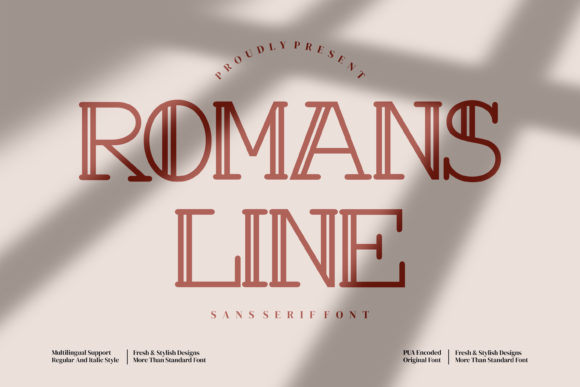
Romans Line is a clean, slightly condensed display font with gentle serifs, balanced letter spacing, and a relaxed rhythm that avoids stiffness. Its lowercase ‘a’ and ‘g’ have soft, open forms; its capitals stand tall without shouting. It’s not overly ornate—no swashes or exaggerated flourishes—so it scales beautifully from 8-point sticker text to 36-inch farmhouse signs. And because it’s designed as a display font, Romans Line shines where impact matters most: headlines, titles, product names, and short decorative phrases.
I use Romans Line across nearly every category I design for: boutique soap labels (paired with a delicate script for scent names), greeting cards (where it anchors bold sentiments like “You’re Amazing” or “Happy Birthday”), wedding welcome boards (especially in muted sage and cream palettes), and seasonal SVG bundles for Cricut and Silhouette users. Last month, I applied it to a set of printable planner tabs—its clarity at 12pt made them instantly legible, even when printed on kraft paper and cut with a rotary cutter.
For physical product makers, readability is non-negotiable—and Romans Line delivers. Its generous x-height and open counters mean it cuts cleanly on vinyl, holds up well on small adhesive labels (think 1.5” x 0.75” tea bag tags), and remains crisp when printed at 300 DPI on matte cardstock. When testing mockups for client packaging, I’ve found Romans Line renders consistently across Adobe Illustrator, Canva, and Procreate—no unexpected kerning shifts or missing glyphs. It’s also highly legible on textured surfaces: I’ve used it successfully on burlap gift tags, ceramic mug decals, and linen tote bag prints.
What sets Romans Line apart from other vintage-style fonts is how easily it pairs with complementary typefaces—without competing. For invitations, I often combine it with a light, airy script (like a flowing connected script) for names and dates, then drop in a neutral sans serif (think Montserrat Light or Inter Regular) for addresses and details. On product packaging, I’ll use Romans Line for the brand name and pair it with a sturdy, no-frills serif (e.g., Lora or Merriweather) for ingredient lists or care instructions. The contrast feels intentional, not cluttered—and customers notice the polish.
It’s worth noting that Romans Line works best for short-form, high-impact text. Think “Small Batch • Hand-Poured”, “Est. 2019”, or “Welcome Home”. It’s not meant for body copy—but that’s exactly what makes it powerful as a display font. Its strength lies in focus: guiding the eye, reinforcing tone, and anchoring your visual identity. When used on a wedding welcome sign beside a chalkboard background, Romans Line says “thoughtful” before guests read a single word. On a candle label beside botanical line art, it whispers “crafted with care”.
I’ve tested Romans Line across multiple seasonal collections—from spring garden party printables to cozy fall market banners—and it adapts effortlessly. In holiday packaging, it adds quiet elegance to minimalist red-and-white gift boxes. For Easter egg labels, its gentle curves echo hand-drawn illustrations without overwhelming them. Even in digital downloads—like editable Canva templates for baby announcements or bridal shower planners—Romans Line gives clients instant brand cohesion, especially when they swap colors or backgrounds but keep the typography consistent.
Before adding Romans Line to your design toolkit, check what’s included in the file package. Most versions offer OTF and TTF formats (essential for Cricut Design Space and Silhouette Studio), basic OpenType features like standard ligatures and alternate characters, and extended Latin language support—enough for English, Spanish, French, German, and Portuguese product labels and multilingual shop signage. There are no stylistic sets or discretionary ligatures, which keeps things simple and production-friendly. No need to hunt for hidden glyphs—what you see in the specimen sheet is what you get in practice.
One practical note every handmade seller should keep in mind: Romans Line is licensed for commercial use, including physical products, digital downloads, SVG files, templates, and client work—provided you’re using it as part of your original design (not reselling the font files themselves). That means you can confidently use it on Etsy listings for printable wall art, embed it in PDF planners, apply it to heat-transfer vinyl for t-shirts, or include it in Canva template bundles. Just double-check the license terms for your specific purchase—some vendors include unlimited personal + commercial use, while others specify limits on total sales volume or require an extended license for large-scale merchandise.
If you're building a cohesive brand identity—not just a collection of pretty designs—Romans Line helps unify your offerings. A customer who sees it on your lavender-scented candle label, your Instagram story highlight icon, and your printable gratitude journal cover begins to associate that distinct rhythm and warmth with *your* shop. That kind of consistency isn’t accidental. It’s built, one thoughtful type choice at a time.
Whether you’re sketching ideas on scrap paper or prepping final files for print-on-demand, Romans Line is the kind of display font that supports your process instead of complicating it. It’s versatile without being vague, distinctive without being distracting, and timeless without feeling dated. For makers who value both aesthetic integrity and real-world usability, Romans Line isn’t just another font—it’s a reliable collaborator in every project you bring to life.